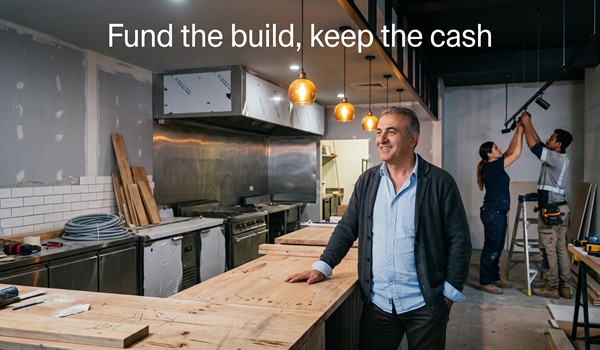
In short:
Paying cash for a fitout drains the working capital a new venue needs to survive its first six months, which is when most closures happen.
Key facts
- Why finance it: Paying cash for a fitout drains the working capital a new venue needs to survive its first six months, which is when most closures happen.
- Cover the whole project: Fitout finance can fund up to 100% of the build, so your savings stay in the business as an operating buffer.
- Staged drawdowns protect cash: Funds release against your builder's progress payments, so you pay interest only on what has actually been drawn.
- Match the structure to the asset: Build works suit a fitout loan, kitchen equipment suits a chattel mortgage, and small projects can use an unsecured facility.
- The decision: Choose the structure that matches your lease term and how your revenue ramps, not just the lowest rate.
Most operators treat the fitout as a build problem. It is really a cash flow problem. Venues rarely fail because the joinery was wrong; they fail because the money ran out three months after opening, while trade was still building. How you fund the fitout decides whether you open with a runway or open on empty. This guide covers why financing protects your cash flow, and which structures suit which parts of the project. It is general information, not financial advice.
Why financing the fitout protects your cash flow
Hospitality runs on thin margins and slow ramps. The restaurants industry is worth around $26.2 billion, according to IBISWorld, but thin margins are the sector's defining pain point. A new venue does not reach steady trade on day one. It takes months to build a regular customer base, and through that period rent, wages, stock, and utilities all fall due regardless of how many covers you turn.
That is the case for financing rather than paying cash. Sink your savings into the build and you open with a beautiful venue and no buffer. One slow month, one equipment failure, or one delayed licence and you are borrowing under pressure at worse terms than you could have arranged beforehand. Financing converts a large one-off outflow into a predictable monthly repayment matched to the life of the asset, and leaves your cash covering the operating gap until trade catches up.
There is a tax dimension too. Interest on a business fitout loan is generally deductible, and the completed fitout becomes a depreciable asset, so structured correctly the after-tax cost sits below the headline price. Your accountant should confirm the treatment for your situation.
The finance structures and what each suits
Hospitality fitouts are rarely funded by one product. Different parts of the project suit different structures, and knowing which is which is where operators save money.
Fitout finance with staged drawdowns
This is the standard structure for the build. A term loan covers the fitout cost, but rather than landing as a lump sum, funds release in stages tied to your builder's progress payment schedule. The cash flow advantage is direct: you pay interest only on what has been drawn, so you are not carrying the full loan while the site is still a shell. Terms typically run three to seven years, with the fitout as the primary security.
Equipment finance for the kitchen
Kitchen equipment is the most expensive part of most projects and finances differently from the build. Combi ovens, refrigeration, dishwashers, and coffee machines are discrete assets, so they suit a chattel mortgage. You own the equipment from day one, and a GST-registered business can generally claim depreciation and the interest portion of repayments, plus the GST as an input tax credit. Because the equipment secures the loan, approval is often easier than unsecured lending.
Unsecured business loan
For smaller refurbishments, or where you would rather not grant security over the fitout, an unsecured facility is approved on your revenue and credit profile instead of an asset charge. It is typically available up to around $250,000 and is faster to arrange, at a higher rate. Where construction, equipment, and furniture are all sourced together, they can often be bundled under one facility with a single repayment.
| Structure | Best suited to | Cash flow benefit |
|---|---|---|
| Staged fitout loan | The construction build | Interest only on funds drawn |
| Equipment finance | Kitchen and coffee equipment | Asset security, tax deductions |
| Unsecured loan | Smaller refurbishments | Fast, no charge over fitout |
Reduce what you need to borrow
Before sizing the facility, negotiate the lease. Landlords frequently offer a fitout contribution to attract tenants, particularly on longer terms, which directly reduces what you finance. Negotiate the incentive first, then fund the gap, remembering landlords often build incentives back into the rent.
A realistic scenario
Picture a first-time operator opening a cafe in Melbourne with a fitout quoted around $300,000 and $120,000 in savings. Paying the maximum they can in cash feels prudent, but it would leave barely $20,000 to cover rent, wages, and stock while the customer base builds.
Instead, they negotiate a $40,000 landlord contribution on a five-year lease, then finance the remaining $260,000. The build is funded as a staged fitout loan drawing against progress payments, so interest accrues only on funds released, and the kitchen equipment goes on a chattel mortgage. The $120,000 stays in the business as an operating buffer. When the first winter proves slower than forecast, the buffer absorbs it rather than forcing an emergency loan at a worse rate. The fitout was never the risk; the cash position was.
What matters most
Financing a hospitality fitout is a cash flow decision before it is a cost decision. Keep your savings working as an operating buffer, negotiate the landlord contribution to reduce what you borrow, then match each part of the project to the right structure: a staged fitout loan for the build, a chattel mortgage for kitchen equipment, an unsecured facility for smaller works. Structure it that way and you open with a runway that carries you to steady trade. Pay cash for everything and even a strong venue can run out of air first. This is general information only and not financial advice.
Planning a cafe, restaurant, or bar build and want to keep your cash working in the business? Get a hospitality fitout finance quote across 50+ lenders with EasyAsset here.
Frequently asked questions
Why finance a fitout instead of paying cash?
Because a fitout is a long-life asset but cash paid upfront is gone immediately. Financing spreads the cost over the years the fitout earns revenue and keeps your savings available as an operating buffer through the slow opening months, which is when new venues are most vulnerable.
What is a staged drawdown and why does it matter?
A staged drawdown releases loan funds progressively against your builder's progress payment schedule instead of as a single lump sum. You pay interest only on what has been drawn, so you are not carrying the cost of the full loan while the build is still underway.
Can kitchen equipment be financed separately from the build?
Yes, and often it should be. Equipment suits a chattel mortgage, giving ownership from day one plus depreciation and interest deductions for a GST-registered business. Alternatively, equipment and construction can be bundled into a single facility with one repayment if both are sourced at the same time.